
Glycol Coolant Particle Testing for Data Center Liquid Cooling
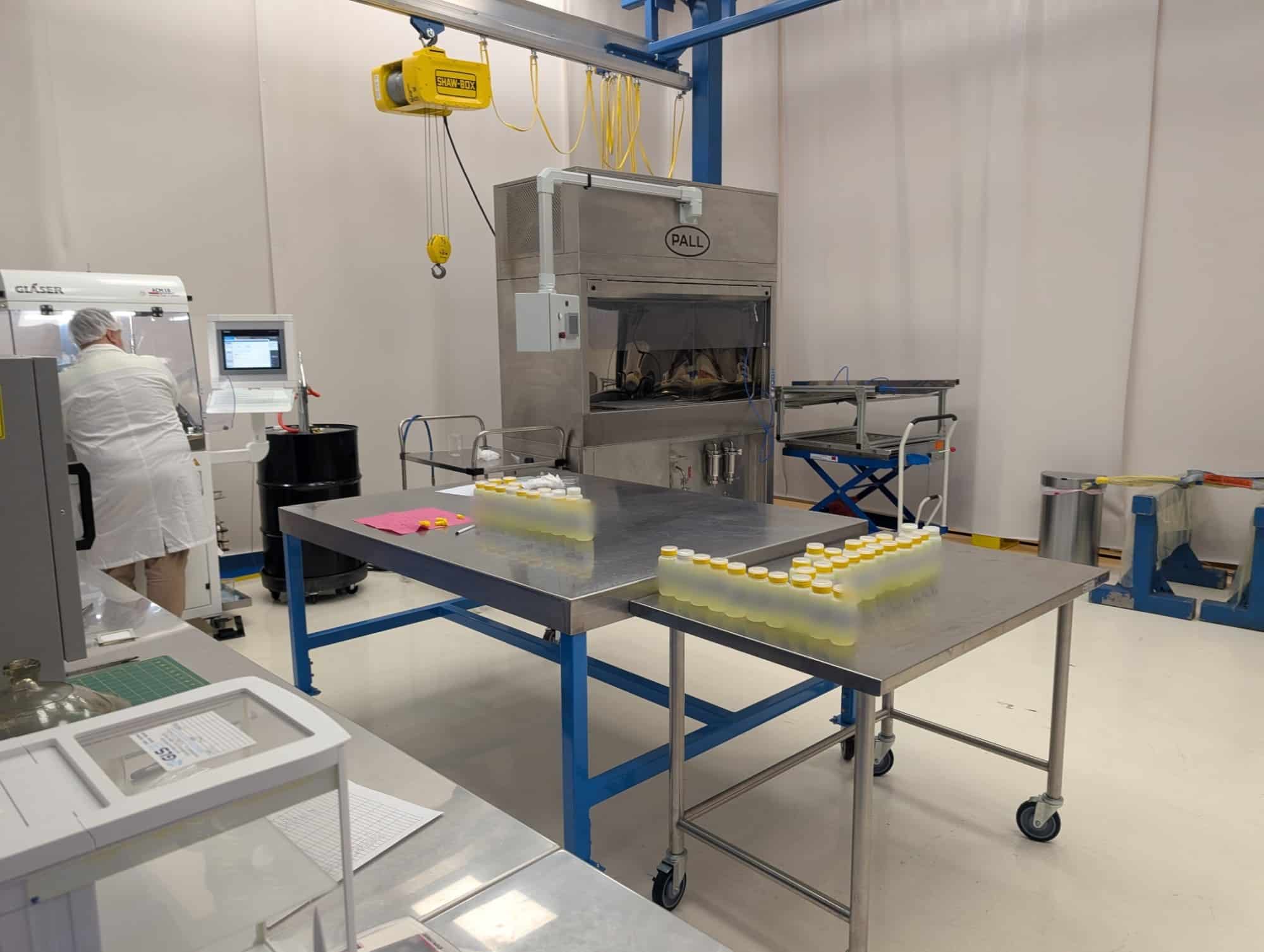
Data center coolant cleanliness testing
Industrial Inspection Company’s cleanliness laboratory in Monroe, Michigan counts and identifies the particles in propylene glycol coolant (PG25) from direct-to-chip liquid cooling loops. Particle testing is what this laboratory was built for. Coolant samples run in the same clean room and on the same instruments as our component cleanliness testing, and they ship to us from anywhere in the world.
What the particle test covers
- A 500 mL fluid sample per sample point.
- Membrane filtration of the sample.
- Automated microscope particle counting and sizing.
- Counts by size, reported per mL.
- Metallic and non-metallic particles counted separately.
- SEM-EDS analysis on request, to identify what the particles are made of.
Why coolant cleanliness matters
Direct-to-chip cooling, also called on-chip cooling, pushes propylene glycol coolant through very small channels in the cold plate. Particles left from machining, brazing, assembly or a new fill can lodge in those channels. A loop usually has to meet a particle cleanliness specification before it carries load and while it runs.
The test gives you the numbers to check against that specification.
What the report contains
- Particle counts per mL by size class.
- Metallic and non-metallic particles reported separately.
- SEM-EDS results for the particles analyzed, if ordered: the elements present and the material class.
Who uses it
- Coolant and water treatment suppliers: independent particle counts on the fluid you supply or the samples you pull at a customer site.
- CDU, rack and cold plate manufacturers: particle counts on test loop coolant, and cleanliness testing of the parts themselves.
- Makers of couplings, hoses, pumps and filters: how many particles a part releases into the loop, by size, with SEM-EDS to trace a particle back to the process that made it.
- Commissioning teams and operators: baseline samples after a flush and fill, and repeat samples once the loop is running.
Instruments
- Clean room with ISO Class 5 extraction cabinets.
- Jomesa HFD automated microscope, which counts and sizes every particle on the filter.
- Jomesa PSE scanning electron microscope with EDS, which reads the elemental makeup of flagged particles on the same filter.
Testing the components too
The parts the coolant runs through are tested in the same laboratory to ISO 16232 and VDA 19.1. A fluid result and a component result from one lab can be read side by side. For how the two tests differ, see coolant cleanliness vs. component cleanliness.
Sending a sample
To quote it, we need:
- The coolant type.
- The number of samples.
- Your cleanliness specification, if you have one.
Bacteria testing is a separate test with its own sample. See bacteria testing.
Ship 500 mL per sample point in a sealed bottle to Industrial Inspection Company, 399 Detroit Avenue, Monroe, Michigan 48162. Call +1 (734) 242-9935, email sales@oemsupplier.com, or use the contact form.
Frequently asked questions
Talk to an Expert – Get Answers Now.
Our specialists are ready to provide fast, reliable solutions tailored to your needs.