
ISO/IEC 17025:2017 Accredited Cleanliness Testing Laboratory
Scope of accreditation
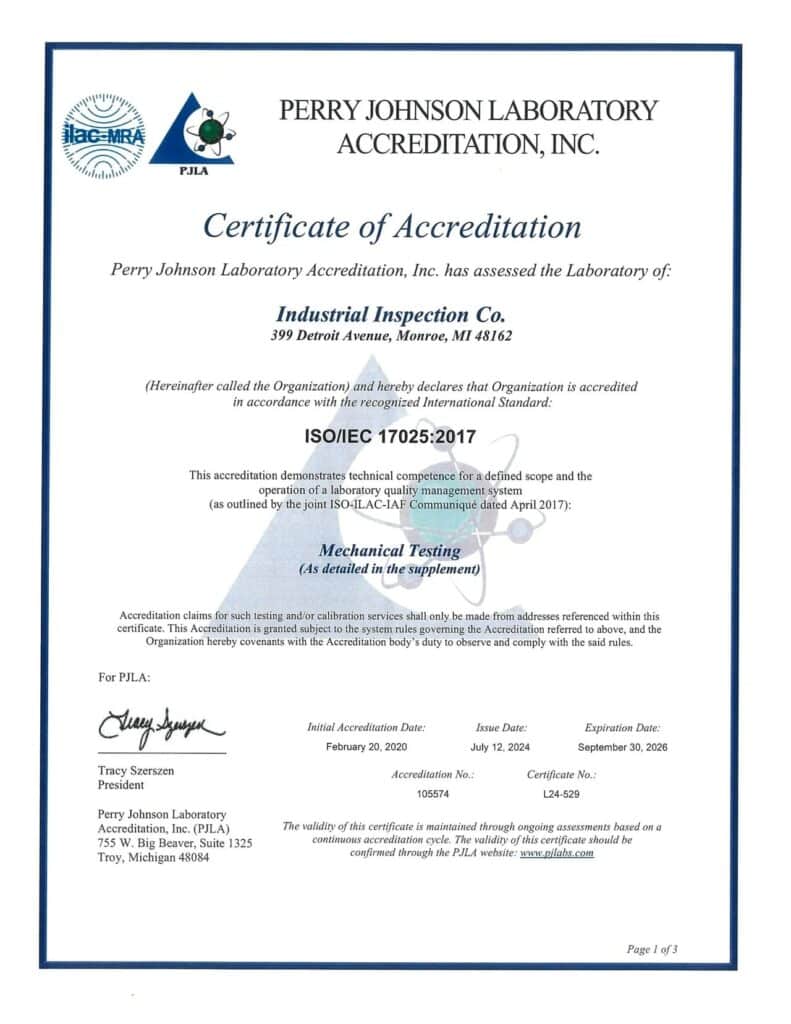
Industrial Inspection Company operates an ISO/IEC 17025:2017 accredited cleanliness testing lab at 399 Detroit Avenue, Monroe, Michigan 48162. The accreditation body is Perry Johnson Laboratory Accreditation, Inc. (PJLA), 755 W. Big Beaver, Suite 1325, Troy, Michigan 48084. The accreditation is No. 105574 under Certificate L26-727, in the field of Mechanical Testing.
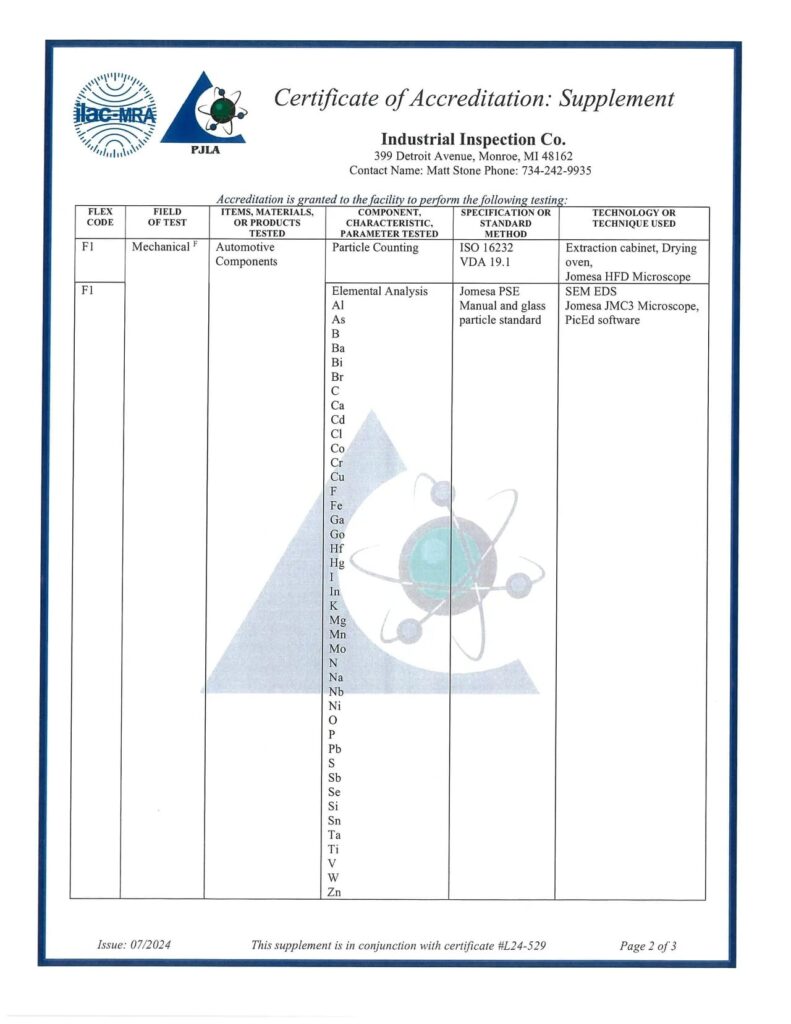
The scope lists two activities on automotive components. The first is particle counting per ISO 16232 and VDA 19.1, using an extraction cabinet, a drying oven and the Jomesa HFD microscope. The second is elemental analysis by SEM-EDS on the Jomesa JMC3 microscope with PicEd software, following the Jomesa PSE manual and a glass particle standard. It covers the 42 elements the supplement lists (41 standard symbols plus one entry printed as “Go”, which we have asked PJLA to confirm).
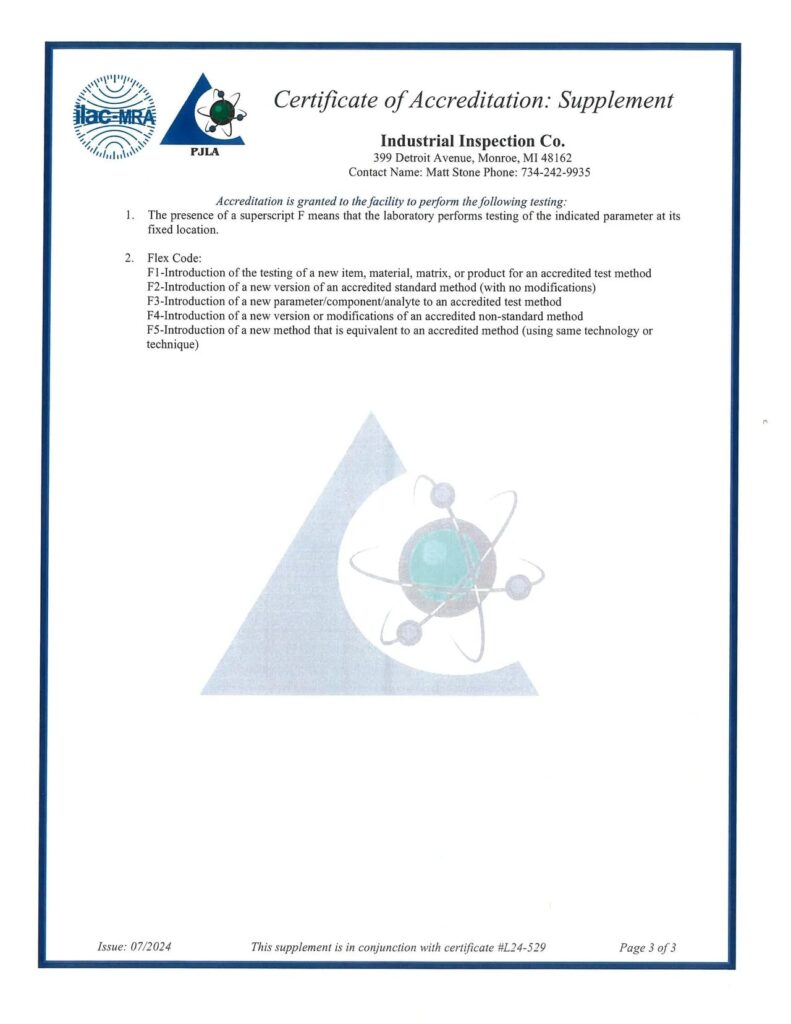
The scope table is reproduced on the supplement pages shown above. Location F means the activity is performed at our fixed facility, and accreditation claims are made only for work done there. PJLA first accredited the laboratory on February 20, 2020. The current certificate was issued August 12, 2026 and expires September 30, 2028.
Both lines carry flex codes F1 and F2. The supplement prints the full key, F0 to F5:
- F0: fixed scope item. No deviations, except updating to the most recent version of an accredited standard method after verification.
- F1: may test a new item, material, matrix or product similar in composition to one on the scope.
- F2: may introduce the newest revision of an accredited authoritative standard method on the scope, with no modifications.
- F3: may introduce a parameter, component or analyte to an accredited test method on the scope.
- F4: may introduce a new revision of an accredited non-standard method using the same technology or technique.
- F5: may introduce a validated method equivalent to an accredited method, using the same technology or technique.
For this laboratory, F2 means the newest revision of ISO 16232 or VDA 19.1 can be introduced with no modifications, after internal verification. Neither line carries F3, F4 or F5.
What accreditation means
The accreditation body has confirmed the laboratory’s technical competence for the activities on the supplement. For your quality team that means:
- Independently assessed competence. PJLA reassesses the laboratory on a continuous accreditation cycle, and the certificate stays valid only through those assessments.
- Traceability. ISO/IEC 17025 requires results to be traceable through calibrated equipment and reference materials; the supplement names the glass particle standard used with the SEM-EDS method.
- Impartiality. ISO/IEC 17025 requires the laboratory to be structured and managed so that commercial, financial or other pressure does not compromise its impartiality.
- Controlled methods. The lab runs ISO 16232, VDA 19.1 and the SEM-EDS method under documented procedures, with extraction parameters qualified for each component. Any departure from a method has to be documented, justified and accepted by the customer.
On the report, results from the two scope lines, the ISO 16232 / VDA 19.1 particle count and the SEM-EDS elemental analysis, are issued under the accreditation. Gravimetric residue is measured within the ISO 16232 / VDA 19.1 procedure and is not a separate line on the scope supplement; ask us whether a gravimetric result on your report is issued under the accreditation. CMM dimensional inspection, calibration and NDT are outside the scope and carry no accreditation claim.
Verify the certificate
Download the ISO/IEC 17025:2017 certificate and scope supplement (PDF); the certificate and both supplement pages are also shown above. The certificate directs readers to confirm its validity on the accreditation body’s website, www.pjlabs.com. Read the supplement, not the cover page. It lists which tests are covered under Certificate L26-727 and is the source of the table above.
Accredited methods
Both scope lines run in our cleanliness testing laboratory in Monroe, Michigan. Line 1, particle counting, backs the ISO 16232 and VDA 19.1 cleanliness testing service: extraction, analysis filtration and automated particle counting on the Jomesa HFD. Line 2, elemental analysis, backs SEM-EDS particle analysis, which identifies what each particle on the filter is made of, for the elements on the supplement. A part can be counted and its particles identified in one test at the Monroe facility, with both results under one accreditation. Request a quote with your drawing and cleanliness specification.
Frequently asked questions
Talk to an Expert – Get Answers Now.
Our specialists are ready to provide fast, reliable solutions tailored to your needs.